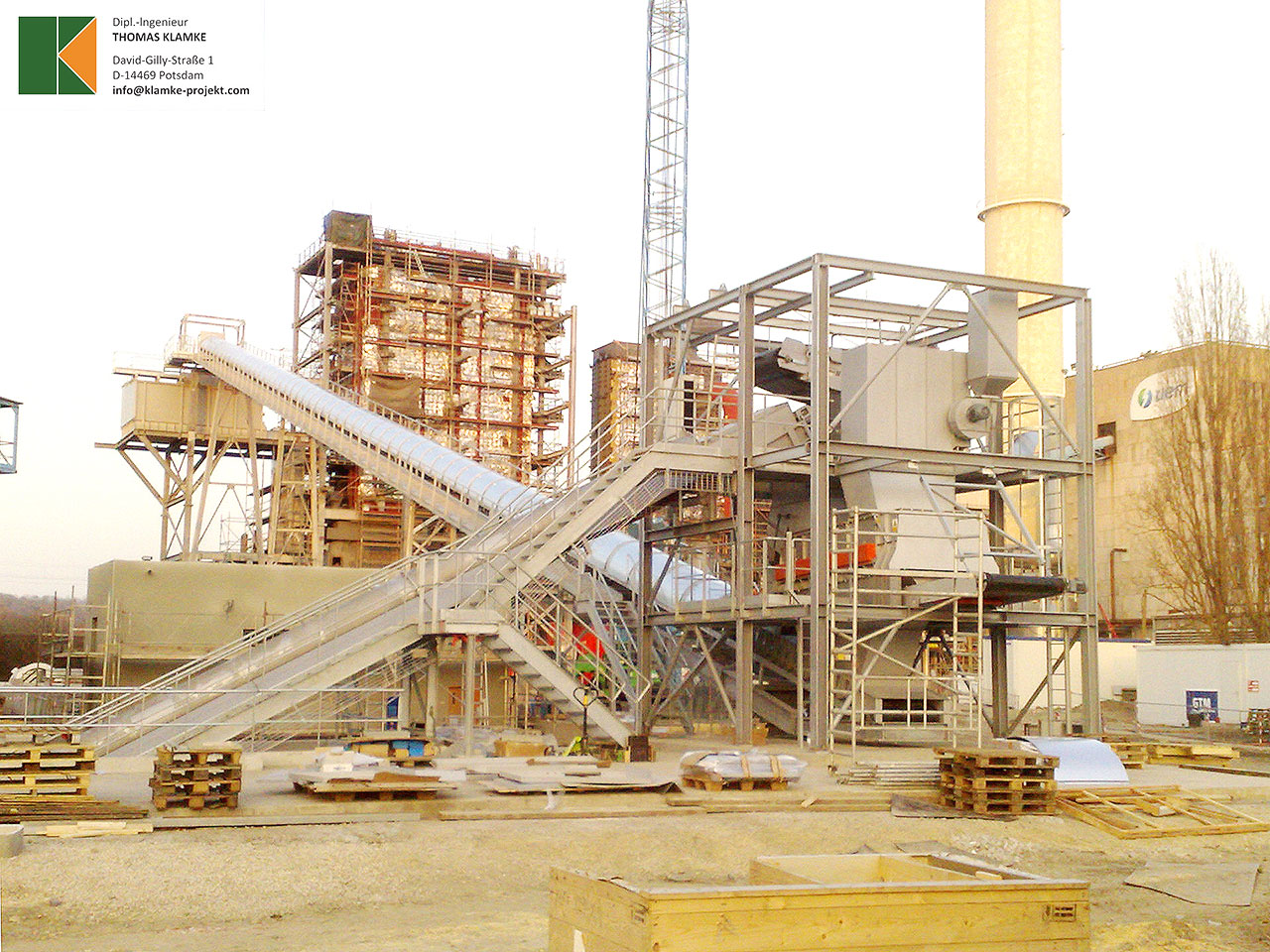
In contrast to the conventional design of a belt conveyor, in which the upper strand of the belt runs over idlers that both limit the sag of the belt and cause it to trough, in this type of conveyor the belt runs through a pipe. The design has several advantages:
Supporting structures of the air-supported belt conveyors:
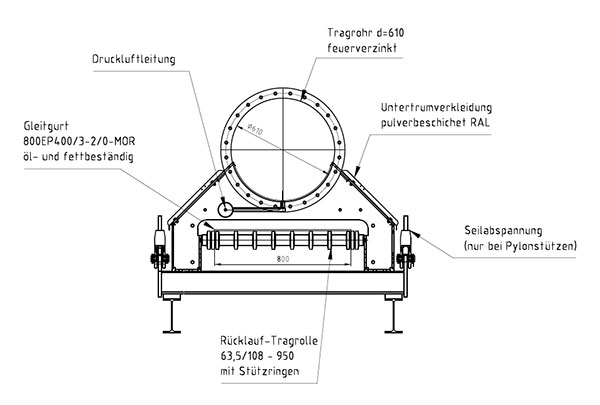
The supporting pipe rests on support flanges on the bottom chord level. Here "bottom chord” refers to the platform-like support layer of the steel structure. The combined cross-section of the pipe and steel support layer stabilises the structure both vertically (dead weight, bulk material and snow) and hori-zontally (wind). The support spacing distance is increased compared to the variant in which the weight is borne by the pipe alone.
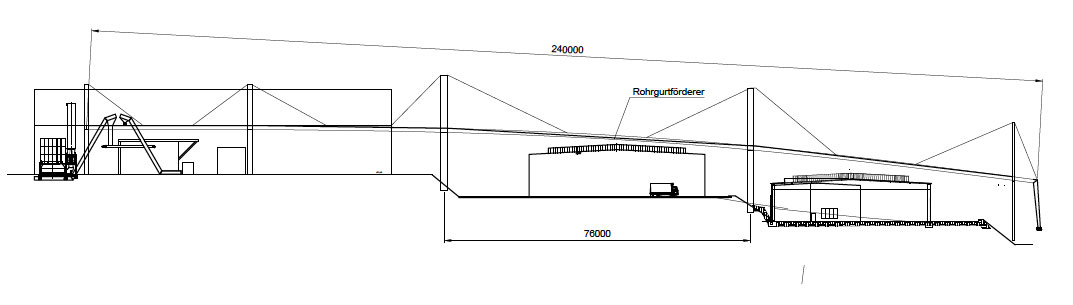
In order to achieve particularly large support spacing distances of up to 76 m, the air-supported belt conveyor can be suspended on cables between pylons.
Air-supported belt conveyors are thus used as
The air-supported belt conveyor requires very little maintenance, as virtually only the return rollers in the lower run of the belt have to be inspected and replaced. Idler rollers are lubricated for life and do not need to be re-lubricated during operation.
Nevertheless, in order to perform an inspection of the conveying line the conveyor can be equipped with an auxiliary device:
The inspection trolley is an innovation developed by the Klamke engineering office and is not yet state of the art. The trolley is equipped with electrical equipment consisting of a
This allows the trolley to travel up and down the full length of the conveyor one and a half to two times before the battery needs to be recharged. The bottom chord level of the steel support structure (see above) serves as the trolley support frame.